

Converting Commercial Buildings from Gas to Heat-Pump Hot Water
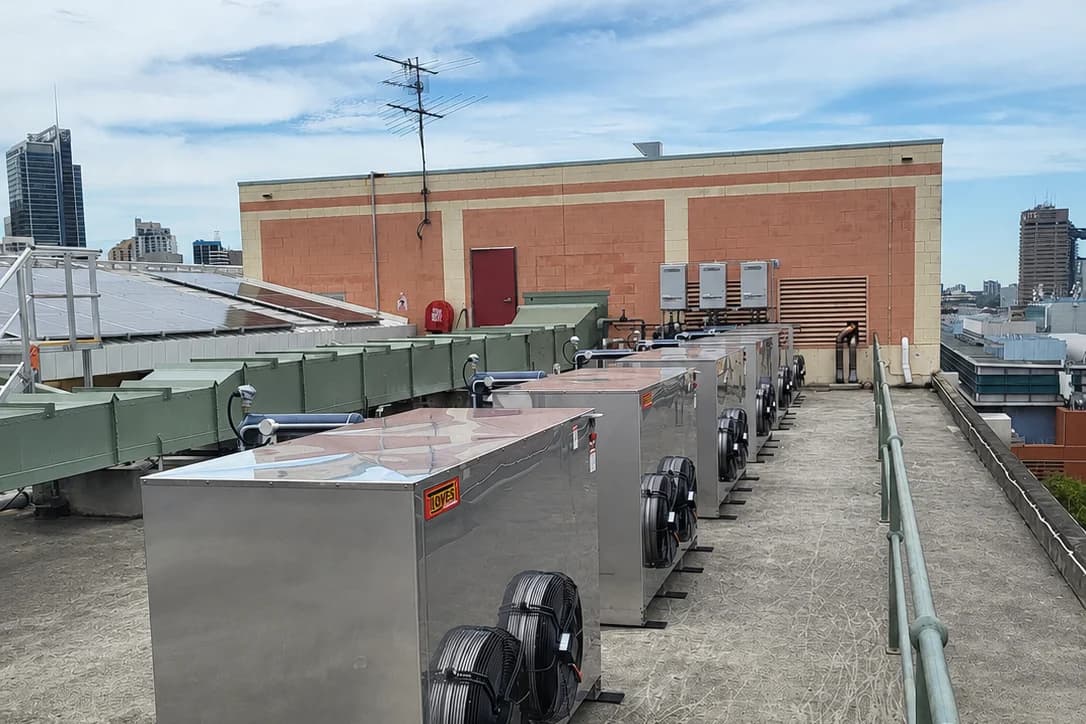
Gas has quietly become a liability for commercial building owners. Network prices are volatile, several states are phasing gas out of new buildings, and every sustainability rating scheme now rewards electrification. For most commercial sites the single largest gas load is hot water — which makes hot water plant the first, and highest-impact, system to convert.
This guide covers what a gas-to-heat-pump conversion actually involves: getting the capacity right, protecting recovery rate, the rating and cost implications, and how to stage the work so occupants never lose hot water.
Why hot water is the place to start
Space heating, cooking and hot water are the three usual gas loads in a commercial building. Hot water is the one that runs 365 days a year, so it delivers the most consistent emissions and cost saving when electrified. It's also the most self-contained — a plant-room swap rarely disrupts tenancies the way a heating conversion can.
Commercial heat pumps extract ambient heat and move it into the water, delivering roughly three to four units of heat for every unit of electricity. Paired with a decarbonising grid (and on-site solar where available), that turns your largest thermal load into one of your cleanest.
Capacity and recovery: the part most conversions get wrong
A like-for-like swap of a gas heater for a heat pump almost always disappoints. Gas burners deliver very high instantaneous output; heat pumps deliver steadier output over time. Size a system on peak instantaneous demand alone and you'll over-capitalise; size it on daily volume alone and you'll run short during morning and evening peaks.
The right approach is to design around both the daily hot water volume and the building's demand profile, then use appropriately sized storage to buffer the peaks. For hospitals, hotels and large residential buildings — where a cold shower is not an acceptable failure mode — storage and redundancy matter as much as the heat pump rating itself. Getting recovery rate right is the difference between a system that quietly performs and one that generates complaints.
Heated and stored water should be designed to AS/NZS 3500.4 and AS/NZS 2712, with warm-water temperature and Legionella controls to AS 4032 and AS/NZS 3666 — electrification does not remove those obligations, and a heat pump's lower delivery temperatures make thermal disinfection strategy more important, not less.
What it does for your NABERS and Green Star position
Electrifying hot water directly improves a building's energy and emissions performance under NABERS, and supports Green Star credits on refurbishment and new-build projects. As grid emissions factors fall and gas factors don't, an all-electric building's rating trajectory improves over time — a gas building's does not. For owners with portfolio-level sustainability targets, hot water electrification is usually the most cost-effective rating gain per dollar spent.
The real costs — and where the payback comes from
A conversion is more than a heater. Budget realistically for:
- The heat pump units and storage vessels
- Electrical capacity — many older buildings need a switchboard or supply upgrade
- Plant-room space, structural and acoustic considerations (heat pumps need airflow and generate noise)
- Controls and integration with the building management system
Against that, the payback comes from lower running costs (three-to-four-times efficiency versus burning gas), removal of gas supply charges once the last gas load is gone, reduced carbon-related exposure, and the asset-value uplift of a higher-rated, future-proofed building. Rebates and incentives for commercial electrification are available in several jurisdictions and should be factored into the business case.
Staging the switch without downtime
Occupied buildings — hospitals, aged care, hotels, apartments — can't lose hot water. A well-run conversion is staged:
- Assess the existing plant, loads, electrical capacity and space.
- Design the heat pump and storage configuration for volume and peak recovery, with redundancy for critical facilities.
- Install the new plant alongside the existing gas system, so supply is never interrupted.
- Commission and prove the new system under real load before the gas plant is isolated.
- Decommission gas once the electric plant is verified.
This "install-then-switch" sequence is what keeps a live facility running throughout, and it's why conversions in critical environments should be handled by a contractor that does the design, installation and commissioning in-house rather than coordinating three separate trades.
Where Goldman fits
Hot and warm water is where Goldman is deepest. We design, install and maintain the plant that keeps hospitals, aged-care facilities, hotels and apartment buildings supplied — and we specialise in the commercial-grade heat pump systems that move those buildings off gas without losing capacity or recovery rate, extending to aquatic-centre and pool electrification. Because the design, construction and ongoing maintenance sit under one roof, the system that gets commissioned is the system that gets supported.
If you're weighing up a gas-to-electric hot water conversion for a commercial or healthcare building, that's exactly the kind of project we scope, stage and deliver.