

Legionella Risk Management in Hospitals and Aged Care
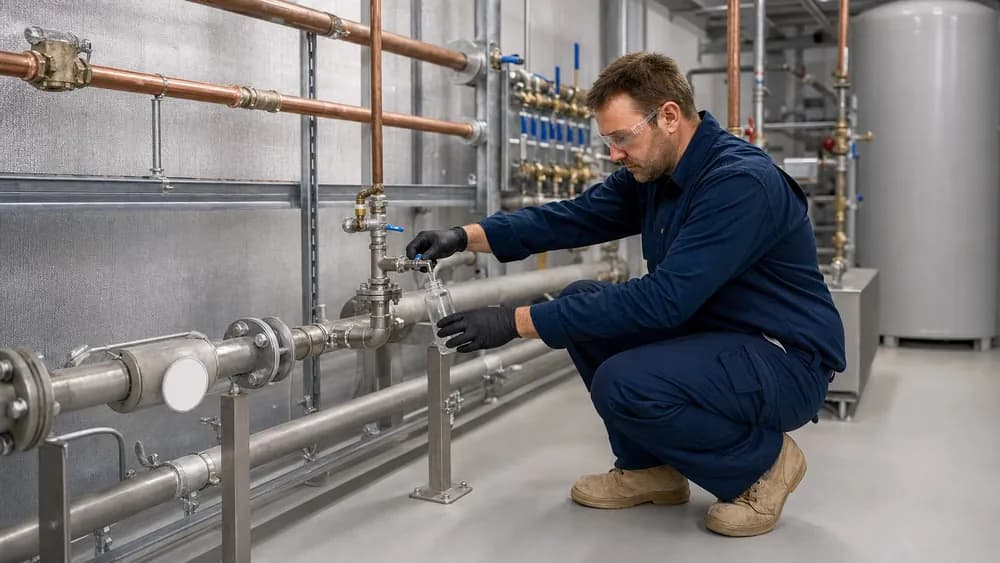
Hospitals and aged-care homes are where Legionella does the most harm. Their residents and patients are more likely to be older, immunocompromised, recovering from surgery or living with chronic lung disease, which are exactly the groups most vulnerable to Legionnaires' disease. They also run some of the most complicated water systems of any building type: large heated water plant, long pipe networks, hundreds of thermostatic mixing valves, and outlets that can sit unused for days.
This guide covers how warm water systems create Legionella risk, what NSW requires of healthcare facilities, how a risk management plan works, and the practical controls (temperature, sampling, TMVs, flushing and remediation) that keep a system healthy.
Why warm water systems carry the risk
Legionella bacteria grow in water at the temperatures found in warm water systems, particularly where water stagnates and biofilm builds up on the inside of pipes and fittings. Healthcare facilities face a built-in conflict here. Stored hot water needs to be hot enough to control bacteria, while water at the outlet has to be cool enough to prevent scalding.
Under the NSW Public Health Act 2010, a warm-water system is one designed to heat and deliver water at less than 60°C at each outlet. Most healthcare facilities achieve safe outlet temperatures with thermostatic mixing valves (TMVs), which blend hot and cold water close to the point of use. The National Construction Code limits delivery temperature at sanitary fixtures to 45°C in patient care areas of health-care buildings and residential parts of aged-care buildings. The pipework downstream of each TMV holds blended water in the range where Legionella can grow, and that is why TMV design and maintenance sit at the centre of Legionella control.
What NSW requires of healthcare facilities
In NSW the most specific obligations apply to hospitals. Note that the Public Health Act 2010 defines "hospital" to include a nursing home, so some residential aged-care facilities are captured as well:
- Approved systems. Under the Public Health Regulation 2022, a warm-water system must not be installed in a hospital unless it is of a kind approved in writing by the NSW Health Secretary. NSW Health publishes the approval specifications for warm water systems and TMVs.
- Operation and maintenance. Warm-water systems must be operated and maintained in line with AS/NZS 3666, and NSW hospitals must also follow NSW Health's policy directive Water: Requirements for the Provision of Cold and Heated Water (PD2015_008).
- Notification. The local council must be notified when a warm-water system is installed, using the approved form, and told of any later change in the details.
- Microbiological standard. PD2015_008 requires that water sampled from personal ablution outlets in hospitals contains fewer than 10 Legionella colony forming units (cfu) per millilitre. Where results exceed this, a disinfection process must be built into the system.
- Monthly temperature checks. A temperature safety check must be done monthly at at least one outlet served by each TMV or warm water system. If the temperature varies by 2°C or more from the specified range, the system must be isolated until it has been checked and repaired.
Aged-care facilities should not assume they are exempt. Whether your facility falls within the Act's definition of a nursing home affects which of the obligations above apply, so confirm its status with your local council or public health unit. The national enHealth guidelines (described below) are written for both health and aged-care facilities. If you operate interstate, rules differ. Queensland, for example, requires public hospitals, licensed private health facilities and Queensland Health-operated residential aged-care facilities to have and follow a water risk management plan.
The risk management plan
A Legionella or water risk management plan is the document that ties everything together. The national framework is the enHealth Guidelines for Legionella Control in the Operation and Maintenance of Water Distribution Systems in Health and Aged Care Facilities, published with a national risk management plan template. A good plan should:
- Describe the water system. That means the incoming supply, storage and heating plant, ring mains, TMVs and outlets, with up-to-date drawings.
- Identify the hazards. Look for dead legs, low-use outlets, poor circulation, temperature failures, unsuitable materials and areas housing high-risk patients.
- Assess the risk of each hazard, considering both the system and the people it serves.
- Set control measures, such as temperature control, circulation, flushing, disinfection and water treatment equipment.
- Define monitoring and corrective actions. Set out what gets checked, how often, the critical limits, and what happens when a result falls outside them.
- Specify record keeping and review, so the plan stays current as the building and its use change.
PD2015_008 also expects NSW hospitals to plan for site auditing, a flushing program for unused outlets, elimination of dead legs, localised and system disinfection, and a contingency plan for Legionella detections, including how patients and communications will be managed.
Sampling: verifying the controls work
Sampling does not replace control measures. It tells you whether they are working. For NSW hospitals, PD2015_008 states that warm water systems should be sampled at least twice a year until the system's Legionella profile is established. Sampling may then drop to annually if results stay satisfactory. Transplant centres must sample quarterly at minimum. As a guide, it suggests at least 10 distal sites for hospitals of up to 500 beds, with more for larger facilities, chosen on risk and rotated over time.
Samples should be representative of what patients actually receive. They are taken from showers, basins or baths using aseptic technique and analysed by a laboratory for Legionella counts.
The day-to-day controls
- Temperature. Keep stored and circulating hot water at the temperatures required by AS/NZS 3500.4 and the system design, and monitor TMV outlet temperatures monthly.
- TMVs. Service and field-test each valve to AS 4032.3 and the manufacturer's instructions. See our guide to TMV and backflow compliance in NSW.
- Flushing. Run low-use outlets regularly to prevent stagnation, and record it.
- Dead legs. PD2015_008 requires dead legs in hospital pipework not to exceed 10 metres or 2 litres, whichever is less. Remove redundant branches during refurbishments.
- Water treatment. Where water quality or system design demands it, use treatment such as chlorine dosing, UV disinfection or copper/silver ionisation, maintained to the manufacturer's recommendations.
When a sample comes back high
An elevated Legionella result should trigger the response set out in your plan. That usually means investigating the cause, carrying out a system sanitation or disinfection within the required timeframe, resampling to confirm the result, and documenting every step. Scheduled preventative disinfection also helps by removing biofilm before it becomes a problem.
Where Goldman fits
Goldman Plumbing provides Legionella Risk Management Plans to the health care and aged care sectors, and is a member of the Legionella Management Advisory Group. Our water treatment team inspects hot and warm water systems to identify higher-risk areas, carries out scheduled water sampling and monitoring across NSW, QLD, VIC and SA, and performs system sanitations with documentation provided for your compliance records. We have also delivered hospital warm water projects, including a central warm water to TMV conversion at Woy Woy Hospital and an emergency warm water plant replacement at Blacktown Hospital.
Learn more about our health care and aged care services and commercial hot and warm water systems.
Frequently asked questions
What Legionella level is acceptable in a NSW hospital?
PD2015_008 sets a performance standard of fewer than 10 cfu/mL in water sampled from outlets used for personal ablution. Results above this require a disinfection process to be incorporated into the warm water system.
How often should warm water systems be sampled?
For NSW hospitals, at least twice a year until the Legionella profile is established, then potentially annually if results remain satisfactory. Transplant centres must sample at least quarterly. Your risk management plan should set frequencies based on risk.
Do aged-care facilities need a Legionella risk management plan?
Requirements vary by state and facility type. Even where a plan is not legally mandated, the national enHealth guidelines recommend one for health and aged-care facilities, and it is the clearest way to show a regulator or auditor that risk is being managed.
If you need a Legionella risk management plan, a sampling program or a system sanitation, contact our team.
Related service
Talk to Goldman about Water Quality & Legionella Risk Management