

TMV Servicing and Backflow Testing: NSW Compliance Guide
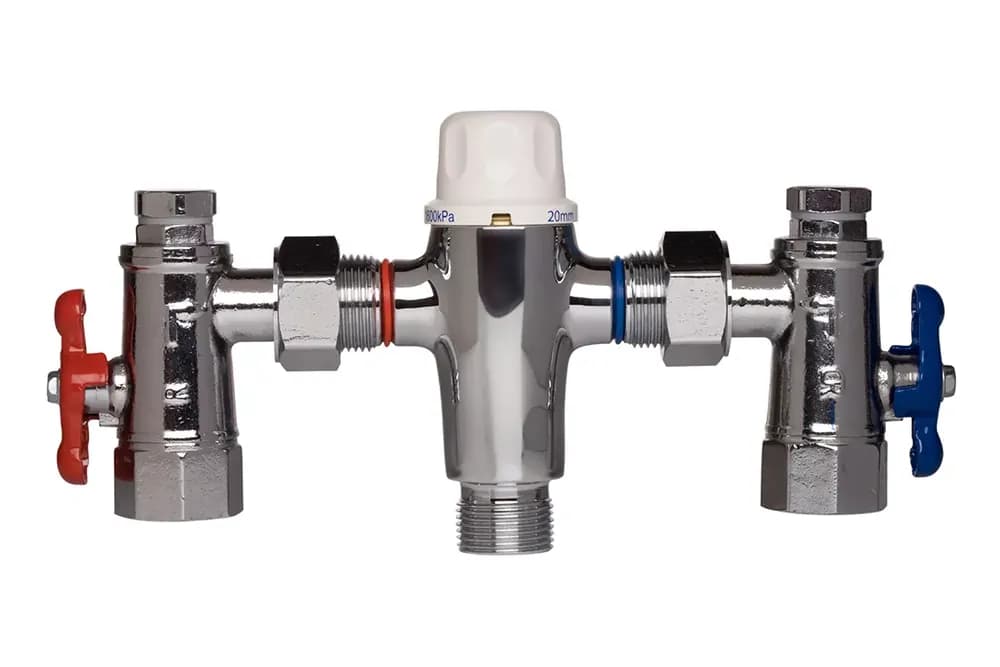
Thermostatic mixing valves and backflow prevention devices are small, easy to overlook, and both are testable devices. Each protects people from a different hazard. A TMV prevents scalding at the tap. A backflow device stops contaminated water flowing back into the drinking water supply. Both need regular testing by an appropriately endorsed plumber, and both create compliance records that building owners are responsible for keeping.
This guide explains what each device does, the standards that apply, how often they need testing, and what hospitals, aged-care facilities and commercial owners in NSW should have in place.
Thermostatic mixing valves: scald protection at the outlet
A TMV blends hot and cold water to deliver water at a controlled, safe temperature, and shuts down if the cold supply fails. TMVs are standard in hospitals, aged-care facilities and accessible bathrooms, where users may not be able to react quickly to hot water.
The National Construction Code limits heated water delivered to sanitary fixtures to 45°C in patient care areas of health-care buildings and in the residential parts of aged-care buildings, and to 50°C in most other cases. TMV work itself is covered by AS 4032.3, the standard for field testing, maintenance and replacement of thermostatic mixing valves, tempering valves and related devices. The current edition is AS 4032.3:2022.
How often TMVs must be tested
TMVs are to be field-tested at least every 12 months, following the manufacturer's recommendations. A risk assessment may call for more frequent testing at some sites. AS 4032.3 also covers the replacement of temperature-sensitive components, so a full service program covers more than the annual test.
NSW hospitals have extra obligations under the NSW Health policy directive Water: Requirements for the Provision of Cold and Heated Water (PD2015_008):
- A monthly temperature safety check at at least one outlet, preferably a hand basin, served by each TMV, with the result recorded.
- Immediate isolation of a warm water system if the temperature varies by 2°C or more from the specified range. It stays out of use until maintenance staff have checked and repaired it and site management has signed off the service report.
- A commissioning and maintenance report for every new TMV and every maintenance visit.
- Servicing by a licensed plumber who is trained and experienced in TMV maintenance.
TMVs in NSW hospitals must also be of a kind approved by NSW Health. Replacing a failed valve is not just a matter of fitting whatever is on the van.
What a TMV service involves
A typical annual service includes checking and recording hot, cold and mixed water temperatures, testing the cold water shut-off (fail-safe) function, cleaning or replacing strainers and checking non-return valves, and adjusting or replacing components as needed, all recorded on a service report. Because the water downstream of a TMV sits at temperatures where Legionella can grow, TMV maintenance is also part of your Legionella risk management plan.
Backflow prevention: protecting the drinking water supply
Backflow happens when water flows the wrong way, from a building's internal system back into the mains or into the building's own drinking water lines. It is usually caused by a pressure drop. In a hospital, aged-care home or industrial site, that water might be in contact with chemicals, medical equipment, irrigation or process plant.
Backflow prevention is set out in AS/NZS 3500.1, which classifies cross-connection hazards as:
- High hazard: could cause death
- Medium hazard: could endanger health
- Low hazard: a nuisance, but not a danger to health
Protection is applied at three levels: containment at the property boundary, zone protection for sections of a building, and individual protection at specific fixtures or equipment. Device selection follows the hazard rating. High hazard requires a reduced pressure zone device (RPZD), registered break tank or registered air gap. Medium hazard requires at least a testable double check valve. Healthcare facilities commonly involve high-hazard connections, but an accredited backflow plumber should confirm the rating for each site.
How often backflow devices must be tested
Testable devices are tested to AS/NZS 2845.3:2020, Field testing and maintenance of testable devices. In Sydney Water's area of operations:
- High and medium hazard testable devices must be tested by an accredited backflow plumber when installed and every year afterwards.
- For containment devices, the plumber must lodge the test results with Sydney Water within 2 days of the test.
- Sydney Water keeps a register of testable containment devices, sends annual reminders, and audits a sample of installations against AS/NZS 3500.1 and AS/NZS 2845.
- Property owners are responsible for installing the correct device and keeping it maintained.
Outside Sydney Water's area, local councils and other water utilities run their own backflow programs. Lodgement methods and timeframes vary, so check with your local water authority. Zone and individual devices inside a building are not lodged with Sydney Water; that plumbing work is regulated by Building Commission NSW.
A compliance checklist for owners and facility managers
- Keep an asset register of every TMV and testable backflow device, with location, make and model, and service history.
- Schedule annual testing for all TMVs and testable backflow devices, with monthly TMV temperature checks in NSW hospitals.
- Make sure contractors hold the right licence endorsements. Both TMV servicing and backflow testing require additional endorsement on a plumbing licence.
- Keep service reports for every device, and confirm that containment device test results have been lodged with your water authority.
- Review device selection whenever a building's use changes. A new clinical area, laboratory or plant item can change the backflow hazard rating.
- Use only NSW Health-approved TMVs for replacements in hospitals.
Where Goldman fits
Goldman Plumbing is licensed to carry out TMV and backflow prevention device testing and servicing, and our technicians hold the required licence endorsements. We test and service over five thousand TMVs and backflow prevention devices each year across QLD, NSW, VIC and SA. Clients receive service reports for their compliance records, and we lodge backflow compliance documentation with the facility's local water authority as required. We have also converted hospital warm water systems to TMV distribution, including at Woy Woy Hospital.
See also our health care and aged care services, water quality and Legionella risk management and 24/7 plumbing maintenance.
Frequently asked questions
How often do TMVs need to be serviced?
At least every 12 months under AS 4032.3, following the manufacturer's recommendations, and more often if a risk assessment requires it. NSW hospitals must also carry out monthly temperature checks on each TMV.
Who is responsible for backflow testing?
The property owner. They must have the correct device installed and arrange annual testing by an accredited backflow plumber, who lodges containment device results with the water authority.
Can any plumber test a TMV or backflow device?
No. Both TMV servicing and backflow device testing require an additional endorsement on a plumbing licence, and in Sydney Water's area backflow testers must be accredited.
What happens if a backflow device fails its test?
It needs to be repaired or replaced and retested, and the result lodged with your water authority. Your water authority sets the timeframe for this.
For TMV and backflow testing across a single site or a multi-site portfolio, contact our team.
Related service
Talk to Goldman about Thermostatic Mixing Valves & Backflow Prevention